Friday, October 19, 2012

The Purpose of Playing God

The physical and chemical properties of the universe are freaking amazing.  Their complexity, stability, scale and resolution of detail are completely breathtaking when considered at any level of comprehension.  Without an equivalent of natural selection by which to explain their emergence it is easy to assume that they must have been the design of a sentient.  Of course the counter argument to this always has been and always will be the anthropic principle - that were the universe any different or any less "spectacular" in design then we would not be here to perceive it so; thus we should not be surprised and cannot logically infer anything about its creation.

In the movie Prometheus the android David asks a human crewmate... 


Why do you think your people made me? 

We made ya 'cause we could.

Can you imagine how disappointing it would be for you to hear the same thing from your creator? 

In the movie Innocence the advertising caption was...


Why are humans so obsessed with recreating themselves?

If the universe was created intentionally then, taking an anthropocentric line of argument, we shall assume that the emergence of sentient life was part of that intention - either for experiment or by design, but ultimately because the creator could create that life.

To what end?  To learn something?  Peter Weyland, from the same school of ambition and entrepreneurship as Eldon Tyrell, gives this powerful speech several years in the future...


Both of Ridley Scott's films come to pretty much the same conclusion; humans learn fuck all from the creation of sentient life.  In Blade Runner the children have shorter lifespans than humans, the humans play god and skirt around the periphery of the drama the Replicants make themselves.  In Prometheus the David 8 android is physically and logically superior to humans and practically immortal, but lacks the fire of the Replicants and humans themselves.  In both cases, the human reactions to their creations are nothing short of ambivalent - it was something that was done because it could be done, and yet the problems of the purpose of creation and human mortality remained - from the human perspective they have created nothing more than an image of themselves, a reflection that is ultimately, as Innocence ponders, obfuscating rather than instructive.

Curious, no, that the creation of life, at least in the thought experiments of intelligent writers, answers no questions about the purpose of the creation of life?

Going back to our hypothetical demiurge, what would it learn from us, its creations?  Were we as a species worth waiting thirteen billion years for?  If we created sentient life, like us, would we benefit in any spiritual or philosophical sense?  Would the creator itself learn anything from our compulsive technological procession?

I think... nothing, no, no and no.

However for writer Iain Banks in the Culture novels, the creation of sentient machines, along with interstellar travel, is a technological leap towards post scarcity and liberal utopia.  The technology itself answers no questions, but makes life while we have it more diverse and stimulating.

Banks is, I am happy to note, quite similar to Tolkien in his take on creation.  For Ronald, for Iluvatar, the act of creation by necessity results in both good and bad consequences, but all add to the glory of life.  The music of Eru is created simply for the joy of doing so.

In the results driven practicality of the modern world where cause and effect can be scrutinized without end, and often censored or trammeled at even the lowest level because the Great Game is all encompassing, it is easy to forget that even the greatest of technological advances can have no more impact than the furtherment of enjoyment for the living.  Or perhaps we should not be surprised at that at all, for perhaps, like the Olympians from whom Prometheus stole fire, revel in the time we have with our fires burning brightly, maintaining one's elan vital, is all life was ever meant to be about.  Perhaps if there is a demiurge, it simply enjoys watching its children play with the fire it gifted them.

Saturday, April 14, 2012

Wednesday, April 4, 2012

Hear that, Jim? More water!


Maybe we should replace your coffee.  Hahaha!

Wednesday, March 7, 2012

Te-tsu-oOo~

Time for another of my pet artistic/philosophical topics.

Music...


For a long time I have been fascinated by the central theme of The Iliad; generally recognised as the first story in the western literary tradition it is curious to me in that it follows a single theme along many threads in an insistent, almost dogmatic, fashion:  Possession.  The possession of women by men, of power by men, of life, death, jealousy, honour, status, trophy, skill, love, respect, immortality and the bodies of fallen friends.  The whole story revolves around players who are constantly seeking the possession of something or someone.

Now this in itself is fascinating; why did the early Greeks craft a story such as this?  Why does the story not cover the beginning nor the end of the war?  What didactic lesson, if at all, was this meant to imbue the listener or reader with when, I think fairly, it can be said there is no conclusion (one might say "point") to the theme?

Well, in my own mind I have I feel answered these questions in part with a new interpretation of the Iliad that I have been building.  To get there, I want to jump forward to Danny Boyle & Alex Garland movies of today...

The three movies they have so far collaborated on, The Beach, 28 Days Later and Sunshine, follow very similar themes and my interpretation of The Iliad requires a preliminary interpretation of these stories.  All three follow a young man into a progressively worsening situation, and on one level chart his responses and eventual "triumph" over the obstacle.  In each case, the man is clearly of middle class origins, educated either in a formal sense or worldly way, but finds no tools within that experience to deal with what he faces.  Instead, he becomes like his aggressors, he becomes animalistic, savage and wild, acts unpredictably and totally unlike his usual self.  Having just written this, I am pleased to find on Wikipedia that Boyle was influenced by Apocalypse Now:

"It had eviscerated my brain, completely. I was an impressionable twenty-one-year-old guy from the sticks. My brain had not been fed and watered with great culture, you know, as art is meant to do. It had been sandblasted by the power of cinema. And that’s why cinema, despite everything we try to do, it remains a young man’s medium, really, in terms of audience."

Brando and Sheen are clearly reflected in the young men of Boyle's movies.  But what does this mean?

Each man is conservative and is forced, for his life, to abandon this for anarchy, to embrace anarchy, to triumph.  In The Beach, the triumph is over the conservatism of the beach community.  In 28 Days Later the triumph is over the anarchy of the zombies and the conservatism of the army.  In Sunshine it is over the conservatism of the pan-theistic religion of the captain (on a side note, what organisation sending a space ship to the sun to save humanity would ever call the ship Icarus, and when it fails - whoops, didn't see that coming - call the next one Icarus II?  Geesh!).  That each man triumphs over a different adversary in each movie is important; and what this signifies is the strength of anarchic-conservatism over either of its constituent parts.

Let's go back to the first story ever recorded; the Epic of Gilgamesh and Enkidu.  The king Gilgamesh represents ultimate conservatism; he has absolute wealth and power in his kingdom, and was famed for the construction of the epitome of conservative architecture; a big wall.  Enkidu is anarchy embodied; a feral man who runs with the animals, he is civilised by procreating with a whore for a week.  Apart they are forces that rival and challenge one another, together they are stronger than anything else in the land.

And forward again to Akira (the movie) by Katsuhiro Ootomo...


Above, Capa (or "Kappa" or "K") and Kaneda attempt to repair the solar shield in Sunshine.  Below, Kaneda and Kei run from the cops.


Above, Kaneda faces down the light of the sun.  Below Kaneda enters the light of Akira to help Tetsuo.

In Akira, the two friends Kaneda and Tetsuo become anarchy realised as they tear up Neo Tokyo.  The Colonel is the force of conservatism, desperately trying to protect the city and its people using all his military power.  The Doctor, the scientist, is portrayed as a short sighted fool possessing neither power.  What succeeds in stopping Tetsuo in the end is not Kaneda (anarchy) or the Colonel (conservatism) but the three espers; Takashi, Kiyoko and Masaru.  Again, they are symbolic of the convergence of anarchy and conservatism; they are childlike in stature and voice, but elder in appearance and power and knowledge.  They stay with the Colonel in safety, but Takashi is escaped by radicals and comes into contact with the bike gang early on.  This dualism gives them the power to summon Akira, to stop Tetsuo.

Finally we may return to the Iliad.  To desire the possession of what one does not have is anarchic, to hold what one has is conservative.  Achilles is the fusion of these elements and this alloyed psyche is his real strength; the conflicting needs to be immortal and yet to be famed gives him a life-force beyond all others.  Hector is representative of all Trojans, excepting Paris; conservative, and thus his and his city's fate are writ.  His father though also conservative, enboldened by Hermes, he, like Boyle's characters or Ootomo's Steamboy, crosses the line into anarchy and does the unthinkable in order to regain the body of his son.


Conclusion

I believe that this simple message, that united anarchy and conservatism are stronger than either force alone, is a pervasive and universal theme of all art.  What I find incredible is that firstly, this was the central theme of the very first written art in the history of civilisation and has persisted 1000 years later with the Iliad and 3000 years later with cinema, and secondly that this message is not taught more explicitly.

It is clearly manifest in history, in contemporary politics and economics, but it is rarely identified.  Yes, the likes of Nietzsche or Freud or Campbell have elicited the basic need for a Hermes like figure to traverse the boundaries of the mind/soul/society/whatever to bring external knowledge to the group and so strengthen it, but nowhere have I seen this insisted upon with such clarity and strength of vision than in Homer, Boyle and Ootomo (and Michael Mann with whose works I've been having a protracted love affair).  Thus, we can answer that riddle from the start, how come this was the theme for the very first art of our cultural history.  At heart, the difference between these artists and the aforementioned academics is one of Action: They are artists of the world, and for men in the world.  Unlike the academics of towers on rare heights or scientists gazing at glowing rectangles, these are men that have themselves been actors in the world, and have transferred that experience to art for others to learn. 


The Music

Is from the soundtrack for the animation Akira, and is composed and performed by a Japanese music "collective" called Geinoh Yamashirogumi.  Every track is remarkable, but this one in particular has an artistic beauty tied to the movie.  Sections of melody decay into chaos, only to be restored by the Buddhist-style chanting, the primal rhythm of a male chorus.  But are they human?  No.  Each instrument and vocalisation becomes an animistic cry from nature.  The deep percussion at the start, the female chorus crying out Tetsuo's name, the priests forcing order, the cacophony of the city in the xylophones, the chorus returning with a lullaby for Akira and Tetsuo - this is the city of Neo Tokyo reacting to and trying to influence the events of the movie.  It screams in pain, rejoices in life and pleads with empathy.  I cannot listen to music anymore unless there is a story, either intrinsic to the piece or provided by mine own interpretation, to accompany.

I hope to see this group perform in August.

Saturday, January 21, 2012

Sue Naami

Sue Naami is the fat lady who bombs the swimming pool.  It's a joke from Scouts.  Said with a New Zealand accent.

I just watched the C4 program, "Japan's Tsunami - Caught on Camera", and it was well worth taking a ganders.  Most of the footage has been shown on TV or the internet before, but the interviews with the camera-peoples were very illuminating, mostly for the largely normal and predictable reactions they all exhibited (except for the totally chilled out guy who said, "Well, what could I do?  I just climbed the tree.").

Ten months on and, well at least here in Shizuoka, you'd be hard pressed to find any evidence in daily life that Japan had suffered it's worst natural disaster since the Great Kanto earthquake crushed and burned over 300,000.  An order of magnitude smaller in the blood cost, about 30,000 people were crushed and drowned.  Trivial!  If I reach into the collective psyche of the culture I now live in, this catastrophe, the instant death of 0.02% of the population, has really registered as nothing more than an event of the year.  A "happening", as the Japanese say in borrowed English, that is quite disagreeable yet nevertheless seems right at home amongst the milieu of bad news that permeates the twilight of fear-driven Western capitalism.

Engage Anti-Capitalist Drive

"The contrast between publicity's interpretation of the world and the world's actual condition is a very stark one, and this sometimes becomes evident in the colour magazines which deal with news stories.  Overleaf is the contents page of such a magazine."
Ways of Seeing, John Berger

The following page shows in the top half refugees from atrocities in Bangladesh in 1971, the bottom this ad for badedas bath products...

"Publicity is essentially eventless.  It extends just as far as nothing else is happening.  For publicity all real events are exceptional and happen only to strangers."

I witnessed no stronger proof of Berger's argument than what happened to publicity in Japan after March 11th.  The commercials on TV just stopped.  For weeks.  Only one company, one suspects at the behest of the government or TV stations since nobody wants consumers remembering a time when there were no ads, continued to "advertise" on TV.  But these were thirty second, "We can do it, Japan!" "commercials" for a company which nobody has a clue what they actually do.  They only had three or four commercials in their portfolio, and indeed viewers got so irritated by seeing the same commercials, often back to back, day in day out, the company even made some more.


If you watch this 100 times, I guarantee you too shall grow to hate this kid.

Berger's assault on Capitalism from this point is merciless...

"Publicity exerts an enormous influence and is a political phenomenon of great importance.  But its offer is as narrow as its references are wide.  It recognizes nothing except the power to acquire."

"Publicity turns consumption into a substitute for democracy.  The choice of what one eats (or wears or drives) takes the place of significant political choice.  Publicity helps to mask and compensate for all that is undemocratic within society."

"Capitalism survives by forcing the majority, whom it exploits, to define their own interests as narrowly as possible.  This was once achieved by extensive deprivation.  Today in the developed countries it is being achieved by imposing a false standard of what and what is not desirable."

He is perfectly correct.  TV stations just cut everything for round the clock news commentary for several days, since no existing program could cope with the reality presented by the disaster.  The silence of Japanese culture spoke more about itself in that week than it has ever done in its loud, crass, rock-bottom-denominator days before or since.

Irrespective of what Japan was before, which from my point of view had some very artistically productive and socially vibrant decades within living memory, it is now a consumer-culture par excellence.  Rather like a perverse Orwellian perpetual war culture, Japan is now in a state of goading its citizens to spend more, forget about reality more, worry about China more in a desperate bid to stave off the long defeat.  The long defeat into what?  Into a marginally poorer and more anarchic state than the situation they had the good fortune to be handed to them by America and protected-market policies after the Second World War.  This wholly reasonable reaction to an economic decline would not be so bad if they didn't have to drag the culture down with it, by employing every artistic mouthpiece for hire to bray the monotonous call-to-arms (to support Japanese industry) before the impending Ragnarok.

I think my body is slightly purer for having got that out.

If you buy into Japanese culture, it isn't nearly so bad looking from the inside.  I enjoy some programs on TV, and go to J-Pop concerts and readily engorge my share of complementary tripe as happily as Ralph.  Not two weeks ago we partook of an Arashi concert in Nagoya, had excellent seats in the central arena section, and I boast to my students that I got a wave from Ninomiya.


Man, it was awesome.  I should add that even the lamentation of death is something that is beginning to irk me; currently I am fascinated by pre-industrial/pre-modern fatalism, so even if Japan had commemorated those taken by Poseidon with sufficient European melancholy and pomp, I should have had something to complain about.  Not to mention that today I found myself (kind of) defending the SOPA bill and political lobbying in a forum discussion with some stridently uneducated gamers, it's probably best that I suffer my chronic dualism in silence.  ..........

Saturday, November 5, 2011

Clash of Games


"Men are born for games.  Nothing else.  Every child knows that play is nobler than work.  He knows too that the worth or merit of a game is not inherent in the game itself but rather in the value of that which is out at hazard."
The judge

The latest idea to catch my mind is a proposition I'd like to make - all emotion stems from playing games.

The above quote from Blood Meridian concerns the philosophy of Judge Holden who himself is a hermetic representation of Satan or War, in which he speaks, so he later claims, for the benefit of the kid, to educate him in part on the purpose of life and also in the nature of war.  A while after, he admonishes the kid for not playing the game (which was to scalp as many native Americans as possible for money)...

"You alone were mutinous.  You alone reserved in your soul some corner of clemency for the heathen."
The judge

Recently, over the past few months, a thing that has become an irritation for me has been the practices of the video game publishing company, EA.  Having bought out one of my favourite developers they then trashed my two favourite intellectual properties, turning them into populist, dumbed-down-for-kids crap.  I query myself, and try to ask, why is it that this angers me so?

As the judge is angry and disappointed with the kid, so too I am angry with EA because, from my perspective, they are not playing the game:  I buy games I like, a portion of that money goes back to the developers who profit and go on to make more and better games.  But, in appropriating Bioware's franchises as they did to attack opposition IPs and appeal to the kiddy market, EA broke the rules of the game I was playing.  When the kid broke the rules, the judge tried to kill him.  For me, well, I'm not a war god so I just get pissed off and rant wildly and vow to never again buy a game from EA.

Of course, each plays his own game, and EA and the kid see things differently...

"It was you, whispered the kid.  You were the one."

EA are playing a different game; the game of finance in a popular culture market.  Like the music, movie and, to a lesser extent, book industries of yore, they are currently riding a wave of success in an undereducated market that will buy their mass-appeal drivel for a little while yet.  EA, and other big publishers, have been breaking the game contract with old customers for years, hoping, like the judge, to educate the youth into a new game with new rules.

They can get away with breaking the rules of my game because my rules are not binding, are unenforceable.  In The Merchant of Venice, Shylock and Antonio have a natural and passionate enmity stemming from the different business games that each plays.  Yet in the loan contract they agree upon they willingly treat with each other according to rules they both accept.

PORTIA
You, merchant, have you any thing to say?

ANTONIO
But little: I am arm'd and well prepared.-
Give me your hand, Bassanio: fare you well!
Grieve not that I am fall'n to this for you;
For herein Fortune shows herself more kind
Than is her custom

But the sickeningly happy lovers (and audience, one presumes) cannot accept this game of blood the businessmen are playing, and make a mockery of the court and common sense to rescue melancholic Antonio and punish Shylock - both of whom could not be any more ambivalent.

PORTIA
Art thou contented, Jew? what dost thou say?

SHYLOCK
I am content.

PORTIA
Clerk, draw a deed of gift.

SHYLOCK
I pray you, give me leave to go from hence;
I am not well: send the deed after me,
And I will sign it.

All their venom is nowhere to be found; the game they were playing has been destroyed and with it the context for their emotion.  All that is left is the judgement of the staged court, which has vapourised their contract and ridicules the passion with which they had entered upon it.

Simple, generic Game properties...
  1. A Game consists of Rules and Goals
  2. For a Game to Work, all participants must nominally play according to the Rules
  3. A cheater is a participant who breaks the Rules
And as this generalised game pertains to emotions...
  • Participating in a Working Game is enjoyable
  • A participant who achieves a Goal experiences delight
  • A cheater will inspire hatred in others
And I could define others with greater or fewer caveats, e.g. honour as defence of the Working Game, spite/malice as attack of the working game, etc.

I believe I can trace and explain all emotion from this.  From the kinders I teach who experience joy with the die, or those who have not been taught how to play by their parents exhibiting confusion and anger when they don't win, to old ladies on trains who raise my hackles by asking personal questions without first introducing themselves - all can be systematically defined as individuals playing working, broken and different games as each perceives it for himself, and as I perceive them.

There is a great deal more that can be harvested from this seed, in business, politics, anthropology, art and so on, but I shall save the details for programming.  What do you think?

Returning to the publisher-that-shall-not-be-mentioned, I realise according to this system that I am angry because they broke the rules of the game I was playing and, if a corporation can be angry, they/it must be angry that people like me do not play their game.  Rather than become bitter like the moody merchant, I can't go far wrong finding other developers and other publishers to play with who want to play the same game.... 

But herein lies the melancholia of Antonio.  He is a merchant of Venice, not Rome or Constantinople.  He must go down to the rialto to do business, and must come into contact, however indirectly, in work or at play, with the Jewish usurer he despises so much.  He would do himself and his brother Shylock a massive favour if he just ditched the anti-semitism and accepted the economic structures of Venice for what they are.

ooOoo

What distinguishes a game-game from the games we play as part of life are the boundaries, temporal and physical, that surround and dissociate games of entertainment from all else.  The hallmark of games played out in reality is that they have no clear demarcations and, to greater or lesser extents, they shall affect us.  Provided we buy into the games provided by our society, the culture of that society is itself a buffer that protects us from foreign games that work on different rules.  People playing different games, like the big game publishers that haunt my life, irritate the hell out of us because they don't play by our rules, thus they are cheating.  We could try to call them out, but they might stick us like Doc Holliday...


(I have been working on an interpretation of Blood Meridian, which includes amongst other concepts this interpretation of Games.  The book is easily one of the best books I have read - you should read it!)

Thursday, June 23, 2011

Kidney Stone & Mishima's Will

That's right, I have now officially passed into the era of old age, hereafter doomed to patching up my body as it slowly... well a bit dramatic, but that's how I felt. That's the first part of this post. The second is the means to escape old age.

Continuing what I did before, here is some topical background music to accompany this post...


Woke up and walked to work as normal, except I had a nasty pain in my right groin, not dissimilar to a twisted testicle. It got steadily worse on the way to work, and by the time I had arrived, not thirty minutes later, I was feeling most uncomfortable and quite nauseous. A teacher kindly proffered a chair to recouperate on, but there was no recouperating to be had. After perhaps, 45 seconds on the chair, the pain got much worse, and I decided quickly I wanted to go to hospital. Retelling this to my students later, those who know me well were quite surprised because I always bemoan doctors and hospital and medicine (that's to come, mind you), but there comes a point with pain when even principles must be abandoned.

I was hastily ushered into a taxi cab across the street, and I gasped a request to take me to the nearest hospital. Having resigned myself over to the conveyance of the taxi and the inevitable medical care of Shizuoka's finest doctors, I relaxed all inhibitions I had been placing on myself and let the pain take over.

At university I attended a couple of lectures on "pain", and simply from an academic point of view, the topic is really quite interesting. Kind of like left and right, or a three-body physics problem, pain is something relative that is impossible to define in isolation or measure quantitatively. At first, the pain was intense in my groin and lower abdomen, much like the report of a terrible stomach ache or malicious kick to the testicles. But as the intensity increased, it seemed to be carried up to my brain, and from there force itself upon every part of my body in waves of paralysis and rigidity that were at once both painful and beyond pain so as to be not painful but simply distressing. My consciousness seemed to recalibrate what pain actually meant, but not by turning it off, because it couldn't, but by dissolving it in a mental spasm, overwhelming the sensation of pain with nonsense that induced a semi-paralysis. Instead of suffering pain, I was aware of suffering pain.

Symptomatically, this manifest as rigor, an inability to move or coordinate movements or to speak, and mild hyperventilation.

It was the most intense pain I have ever felt and, unless I do retain youthful world angst and go the way of Mishima, likely the worst pain I shall ever experience. Even if I should happen across some other illness or injury of comparative nociceptive activity, at least I know my brain has some kind of automatic pain-shutdown that comes into effect. Which is certainly of some comfort.

Anyway, back to the back seat of the taxi, I'm writhing and panting like I'm going to die at any moment, and the poor taxi driver is hoping he won't have a dead foreigner to explain to the police. We get to the hospital and I awkwardly throw my wallet at the driver, not caring whether he takes all my cash and my credit cards. He helps me into reception.

Reception lady in the emergency entrance asks, "Do you have insurance?"
".... yes.... but..."
"Do you have an insurance card?"
[whole body shaking, barely standing, hyperventilating] ".... check.... my... wallet..."
[she checks it, but it isn't in there] "You don't have a card, please fill out this form..."
"I've got the fucking money just treat me you lunatic!"

No, I didn't say that. Nurses came and plonked me into a chair and wheeled me away from the [charming] lady, got me on a bed and from then on it was like ER. Doctor, young man, asks me some questions and as I reply in Japanese I am aware of being pleased with myself for maintaining some mental decorum whilst under such pain; the other time I saw a man moaning on a hospital bed like this he was dying from an abdominal aortic aneurysm and he was incoherent. The doctor quite quickly suspects a kidney stone, confirms enlarged right kidney with ultrasound (I don't think he could see the stone with that), they give me a suppository for the pain and soon I am quite mellow, lying in my own bay, thinking what an exciting experience this has all been.

They give me two abdominal x-rays and an x-ray CAT scan to confirm the diagnosis. Older doctor shows me the stone on the CAT scan. He tells me it will hurt again when it comes out. I want to ask him some questions. What kind of stone is it? He says of course it is a calcium stone (I think he is bullshitting, it probably was, but even the next doctor I go to wants to test the stone to check). What caused the stone? He has no idea. What can I do? Nothing, just wait. Nice work doc.

I got some more morphine suppositories, and then go to work. Not being happy with this hospital, I got to another for follow up. Next one is much better, but they couldn't keep to the damn schedule and I have work to go to, so I don't bother going back there either. (Seriously, don't get me started on doctors, I've heard dozens of stories from students on doctors, to add to my own, who make mistakes, once fatally, over prescribe medicine, and are even drunk on duty). At no point did any healthcare professional (cough) give me any advice other than what was written on a leaflet (drink lots of water). Total bill for symptomatic treatment (which is all doctors can do 90% of the time): $400

The internet was, fortunately, much better. Twenty seconds of google-fu and 1 yen of internet and electricity costs turns up the advice that 60oz of olive oil mixed with 60oz of lemon juice melts the blighted stone like tofu cooked with radiation; I made and drank the disgusting concoction (the lemon juice is what makes it unpalatable) three or four times. I know not whether this actually cured me, but I never passed a stone to my knowledge and only suffered mild renal colic once more.

Runaway Horses

The music is by Philip Glass, and is part of the soundtrack to the movie Mishima, written and directed by the Schrader brothers. You can watch the whole thing on Youtube, and you should do [edit - now you cannot thanks to copyright on a movie that doesn't even seem to be in publication any more, try a rental shop]. The second book in Mishima's tetralogy is called Runaway Horses, and it is the finest novel concerning the youth of man ever. It is slow and considered like the middle aged lawyer, Honda, who seeks a connection to his youth, punctured by sections of extreme beauty and purity of idealism. The end of the novel also gives the finest line of prose ever written, which was also used as the final line for the movie.

Isao and his creator Mishima likewise, suffered from a peculiar form of psychache whereby they give a shit about what they themselves think and they ACT on their beliefs. As a form of mental pain, their psychache, the kind that drives action, was of a quality and intensity analogous to the small lump of ill-formed calcium tearing up my ureter. It spurred me onto quick action out of fear and panic, an action that is always in danger of being yielded and diluted to the pressure of daily conformity and numb peace, unless it has an unstoppable progenitor.

The genius of all art lies in self awareness, and Mishima so consistently undermined his own beliefs and those of his characters that he draws point to self awareness in the comedy of taking one's beliefs too seriously, and yet, in spite of that, believes and acts on them anyway. His art was only crystallized, proven by experiment, when he killed himself. The Will to Act.


The self immolation of the rabbit at the beginning of Tezuka Osamu's Buddha sums this up well. The impetus to act, the stone in one's mind causing pain, can manifest a desire to do good, to create or to help, but only in real world manifestation can this impetus be transformed into something worldly, and thus historical, and thus timeless. In this perverse way of viewing action, the fantasy of the mind is in fact a concrete reality from which the certitudes of one's world are born and maintained; when these are acted upon they become something surreal, seeds of a kaleidoscope, born into a physical world where their repercussions are, unnaturally, refracted and distorted eternally in the interpretations of other minds.

I am constantly amazed at how institution and power structures, and the individuals who work for them, act without moral compunction, and without reproach, often killing thousands through such tools like "policy" and "economic theory", yet are unknown, unpunished, and undiagnosed as sociopaths and not sectioned. Yet, someone who believes in something beyond themselves, someone without ego, with morality who acts in their own name and is willing to be punished under that name, someone who dares take up the sword against an individual of an institution, is labelled a terrorist, has human rights stripped from them, and is punished as the worst kind of criminal. The powers that be in modern society are trying to erase the Will to Act, and the impotence of protest and the youth of modern developed society is sickening proof of their success. This is why we find escapism in the tales of those who do act; Mishima, Batman, Mohammed or Buddha. What we should learn is not how to escape, but how to transform thought into action.

Mishima began his regimen of physical and mental perfection when he was 30, which he did not stop until his death 15 years later; I like to think that it took him this long to form a stone in his belly strong enough to found his beliefs on, and jagged enough to drive him towards action. I have a stone, but it is not yet strong enough to stand up to reason; before I act on it I must accept the comedy and pain of belief in order to calcify the stone, lest it dissolves without a trace.

Sunday, May 29, 2011

Picture, Zoom, Face...


There is a collection of this rather minor but hilarious internet meme here.

Friday, March 18, 2011

Earthquake Day

One week ago I was in Tokyo to watch a University Ice Skating competition. This is Fuku-chan. He was skating to Beethoven Symphony #7 IIRC...


The second movement would have been perhaps a good soundtrack for the drama to come. After he finished, the ladies warm-up began. About five minutes into that, I noticed the bench I was sitting on, with Kiyo and Mariko, swaying side to side. Being particularly sensitive to these things, since I am mortally afraid of all earthquakes, I looked around to see the reactions of others. Everyone was watching the skating.

I stood up and said to myself, "Isn't this an earthquake?" About five seconds later, felt like a long time when panicking, others said, "earthquake! Please get off the ice! Earthquake!" And the skaters listlessly swayed off the ice.

In retrospect, it is rather strange, but everyone just stayed where they were. We didn't try to rush out, but stayed exactly where we were and waited. Every time I've been in an earthquake, from slight to fairly large, the same feeling goes through your mind - is it going to get worse or better? And you wait, and wait, for the answer to that question. It's an idiotic response, but that's what I'm thinking about.

In a stroke of minor-divine-luck, Mariko did move, from the bench to the wall a couple of meters behind us. About ten seconds later a stream of water, from some cooling system I presumed, fell from the ceiling several metres overhead right onto the bench where she had been, creating a nice puddle.

When the shaking stopped, everyone left the building.


On my phone, I quickly found out the rough location and the magnitude of the quake, but we knew nothing of the seriousness. After twenty minutes or so of checking the building, everyone re-entered the rink, and the skating resumed, only for us to evacuate again once an aftershock hit.

Our troubles were nothing compared to those directly affected, but it was trying in its own way. All trains in Tokyo stopped. We had travelled about 40 minutes out from central Tokyo to get to the skate rink, and had to get to the other side of Tokyo to our luxury hotel.

We didn't stand a chance. Waiting and taking buses took us barely five miles in one hour. At Tachikawa station we got a first glimpse of the chaos that had begun...


Outside the station a crowd of people unable to get home had built up, long, long lines for jam packed buses. On a big screen TV people looked up to scenes of burning refineries and tsunami damage. It felt like a movie scene, so surreal was the sense that something utterly terrible had occurred. Still trying to get to our luxury hotel, we boarded a bus that took about an hour to take us just one station down the train line; Kunitatchi.

Here we found out that the hotel had actually closed, and they had been trying to call Mariko on her home number. At Kunitatchi we ate at a Hokkaido food restaurant, and were then forced to try to get back to Tatchikawa since there were no hotels in Kunitatchi. Since it was relatively close, I wanted to walk, but the ladies weren't so keen and wanted to take a bus, no problem I thought. We joined a long line in the cold, and I was quite glad that in a stroke of luck I had bought my down jacket that day. Eskimo hood up, I was quite content to wait.


The line moved quickly as two buses came and went, we were sure to get on the next one. So we waited. And waited. And waited for an hour. Then people started to call the bus company, and gradually we realised that the last bus had left without telling anyone that no more were coming. Kiyo and Mami did a good job of running around, telephoning and gathering information, and got us on another bus, after another half hour, going to Tatchikawa.

My mood was, as you might expect, boarding on irritated, but we had arrived in Tatchikawa now and the girls had managed to book a hotel, the Camel Inn, which we were thankful for since most places were fully booked. I was looking forward to getting to sleep.

However, this strange day was about to get a bit stranger. Some guy we had met at the bus stop was waiting for us when we got off the bus. He wanted to take us to our hotel. The ladies were in charge, and seemed grateful for his help, so said OK.

At this point, I should explain that there is a certain type of Japanese person that go beyond friendly and congenial with foreigners, to the point of being leech like and socially awkward. Right away, I detected this kind of inappropriacy with our new guide. He started talking to me in English, saying how he used to live in the US, how he liked F1 and rock music, yada, yada.

But more than this, he didn't fucking know where he was going. He did not live in Tatchikawa, did not know the hotel, nor directions to the hotel. He had asked what "town" the hotel was in, and decided to take us based on this scrap of information. Needless to say he couldn't find it.

At this point, wandering around strange streets at midnight, in my suit, pulling a suitcase, I was seething, and when I get really pissed I don't care if people know. I asked Kiyo if she had been given directions by the hotel - she had. So I walked off and left them with this crazy guy. Kiyo followed me, then the others did, and we found the place in two minutes.

As if this wasn't bad enough, the ladies had - in a display of generosity and reciprocity not within my power to comprehend - offered this guy to share my room for the night. Frankly, the prospect of spending a night with a stranger with serious boundary respect issues was freaking me out. I wish I had a picture of my face then, because you probably couldn't have found a more murderous look on anyone in Tokyo that night.

Thankfully, he saved himself a certain night on the floor and declined the invitation with his happy-go-lucky cheerfulness that had grated me so.

Obviously a part of me is being a real bastard, he seemed to be genuinely trying to help and be friendly. But the equivalent would be me picking up a Japanese family at Victoria station and saying, "hey! The London Grand hotel? Don't know it, but follow me, guvner!" Nice guy, but clearly an idiot.

The hotel was in fact a love hotel...


Posted by Picasa


You have to read the TOWEL caption in a French accent.

Dried, stale, smokey air, karaoke machine with two mics, full length mirror in the shower, boards covering the windows. A classy and comedic end to the day. I washed and prepared for the morning, planning to get up and try to get to work from 6 am. Ended up leaving at 7 am, waiting on a stationary train for over an hour and then giving up on getting home.

We didn't get to see Mami's skating in the end, but she won!

Thursday, March 17, 2011

Time well spent

And who said I play games too much? Eh?


A classic Onion episode that. Who'd have thought I get to use it as real life commentary?

If the situation deteriorates and the word "melt.." shhh! gets used then I shall probably start to write about what's actually happening, but for the meantime I am assimilating, processing, and playing as much Fallout 3 as possible to get perspective on the impending nuclear apocalypse.

A walk in the park

Was going to write about Japanese nationalism, or economics, or philosophy of technology, or some such topical and utterly serious subject, but instead went for a walk with Nami's new camera (a Nikon D3100) and paid for entry to Sumpu park's gardens and historical display in the renovated gate-house (300 yen). Was a nice antidote to the incessant and yet uninformative news barrage I've been subjecting myself to this last week.


Posted by Picasa


I frequently see cormorants in the moats of Sumpu park or nearby rivers, and they are now my favourite bird by far. They sit calm and lean on the surface of the water, then dive and swim like a mini, feathered plesiosaur, their necks protruding from their bulbous body, darting over the bottom scanning for small fish. Walking by I always watch for their return to the surface, not far from where they dove in. I don't ever recall seeing one eating, so they either swallow fish on capture or are rather beautiful yet inept huntsmen.

I missed capturing a picture of this one drying his wings, think I spooked him by stopping behind him. He then took off in what has to have been, short of Icarus himself, the most inept display of flying I've ever seen. The bird flapped its spitfire-like wings so vertically I thought it was trying for a VTOL take-off. Having pushed off from the water with his feet half a dozen times he lumbered high into the air, only to be buffeted back towards me by an oncoming wind. He circled down to the left, flew overhead, and having built up some speed tried again to head into the wind. He made it away, veering to the right and over some trees. I suspect that once out of sight he gave up his pretence of flight and went with the wind to the next pool of water.

I shall have to try to go and see cormorant fishing. Wonder if I could get a domesticated bird...

Wednesday, December 15, 2010

Say hello to my little friend

For students of "power structures", the last few months have been quite interesting in Europe and the US as we have seen a number of tactics used by power structures, primarily governments, big corporations and the US (in this sense not a government but a hegemon), to maintain their power. I find these interesting, because the maintenance of power is rarely called out for what it is, and frequently reported in the garb with which the instigators clothe it. Here are my top three tactics (and I ignore economic ones because they are tied up with a US economic policy I'm still trying to get to grips with), and we'll start with the UK...

1) Kettling Protesters in London: A tea of protest

Seems to be the hot topic in British news at the moment; the police detain large groups of people for many hours on the street, beat up disabled people (and he makes good comments here), break heads, endorse balaclava'd hooligans and threaten child protesters; sounds like something from an anti-Nazi party propaganda film. The 'why' is obvious, and I'll use Bill the Butcher to explain my point...


The Spectacle of Fearsome Acts. That's what preserves the order of things. Fear. So, the police, under orders from above create that fear, and the media oblige by spreading and disseminating that fear into the homes of the country; the aim is to discourage the casual protester, the citizen who disagrees with the government's policy but has no ballot box with which to record that dissatisfaction, from participating in the only other recourse they have - protest.

Oh, and now, turns out their really clever use of the Spectacle of Fear isn't so clever after all and they might just go ahead and ban protest altogether. Oh the poor elites! Godspeed in your fight against the mob!

2) Divide and Rule: China must stand alone

This one is closer to home in Japan and is a trend I've noticed after living here a few years; America does not want Japan and South Korea to be friendly with China. And for that matter, any other country that borders China. This is part of the Great Game to contain China/SCO. Of course, this runs counter to the very geography of the situation, since Japan and South Korea are natural, developed trading partners for a rising China right on the doorstep. America, as world hegemon, as the British Empire or any empire before it, employs divide and rule to maintain it's own influence/power over all parties.

In the past year alone, there has been a serious public image deterioration in Japan towards China for no good reason at all. There have been many "incidents" (most likely orchestrated by the US) that have contributed towards this, and US influence in Japanese domestic politics is probably one of the most indirect, but I'll focus on just the biggest in the public's eyes. There have been repeated incidents involving military vessels at sea. A South Korean warship was allegedly sunk by a DPRK torpedo. A chinese fishing trawler collided with a Japanese Coast Guard vessel, the captain was arrested and then released. And recently DPRK supposedly started a pissing contest with artillery just west of Seoul. Despite the significant amount of ambiguity surrounding all events, they were unambiguously reported ad infinitum on TV as evidence for the militaristic belligerence of China and DPRK.

In a more rational reality, these events merely served to galvanize people for economic and military action. Some of the Japanese I talk to are routinely involved in trade with China, both in industry and tourism, but complain that the Chinese are too aggressive and behave badly, they'd much rather do business in Brazil or India. I don't believe this is true for a moment, Chinese people are just like any other peoples I've met, but this is the psychological perspective that results from incessant pro-US news reporting and high-seas machinations.

3) Alternative media: Yet more corruption? Boring...

Check out the BBC news homepage. Now check out PressTV or AlJazeera or RussiaToday or the Real News Network. See the difference? Whilst the BBC reports on nonsensical "happy" stories, lists only one or two main happenings and dresses everything up with opinion, other stations do a far better job of reporting the current status of the world (minus Africa because no reporters want to go there apparently, except from AlJazeera). Are they unbiased? Of course not, and they still rely on sindicated [sic] news agencies and far too many British presenters for my liking (though there are so many of them I reason they can't all be from the British Council or GCHQ or whatever). The internet has been the birth of the global "alternative" point of view, but there is an insidious aspect to all this.

Recently, Wikileaks has been in vogue, and we'll take this as our case study. I've been following Wikileaks for about a year now, and I think I can safely say that this will be one of the most interesting internet phenomena to discuss in the future. Let's assume, for the sake of argument, that Wikileaks is totally independent, the leaks are genuine and they have no agenda other than the dissemination of truth to destabilise anti-anarchic power structures. So this means we are assuming Wikileaks is utterly honest and benevolent in their own way. In the past 10-12 months or so they have released the Collateral Murder video, the Iraq and Afghan files and now the diplomatic cables. And a handful of other bits. Before that, there was a steady stream of rather interesting leaks, for example the Trafigura incident, or censorship in Kenya that had real-world impact. So, assuming they still receive leaks at the same rate from whistleblowers, and this is being conservative because you'd expect the rate to go up as their public awareness increases, they must be sitting on more and more leaks, which counter to the honest assumption we made, they are not releasing.

So, why do they not release what they must be holding? Why are they releasing the diplomatic cables a handful at a time? The argument is they want to maximise the impact of each release to effect the greatest possible change. There are so many cables, so many leaks, if they released them all at once important injustices might be overlooked or be drowned out, or something. Now this is where I can link it back to the alternative media as a whole, and this is where the alternative media, by doing exactly what they should do, play into the hands of power structure maintenance: they make corruption tiresome. John Doe...


Wikileaks, if honest and independent as assumed, is defeating its stated purpose in the court of public opinion by trivialising war crimes and unjust diplomacy. Likewise, the alternative media provides a valuable tool in the information age... information is very difficult to suppress, so the worst of it should be released slowly and to a limited audience first, from whence it seeps into mainstream consciousness, but surrounded by so much else it loses moral context and the power to shock people into action.

Now there are other effects that could still play out for "good", such as Assange's paper on conspiracy networks (very interesting that) or real-world courts taking action on this information, provided they aren't bought, but in general there is no doubt that the alternative media has become an important tool for power structures, as long as they don't step over the line.

(I realize this line of reasoning is quite self-defeatist, and the root problem is probably the deliberate news glut manufactured by News Corp et al to create an information overload of essentially worthless information. Wikileaks in particular has, again assuming good, done a decent job of carving out a platform for more important news, scientific journalism as Assange calls it).

Conclusion

So looking at all this, and countless other protests and injustices in the name of authority, most would reasonably side against the powers that be. But what irritates me about the activist movement is nobody ever stops to ask the question, "Why is the maintenance of power a bad thing?" it is always implicitly held that the truth is best. Japan has enjoyed peace and wealth at the cost of political integrity, but many people, including myself, enjoy the fruits of that. "It is warmer than you expect under the wing of a dragon". Conversely, there is an obvious danger that imperialists lose sight of the ends that they fight for and end up fighting on the wrong side. Padme...


All of the above techniques for the maintenance of power structures came to the fore, in the media, in the past year, and are largely as a result of US military and economic strategies that are seeking to guarantee US hegemony into the near future. The dollar as global trading currency is under threat, has been for some time, and it seems probable to me that the "sub-prime mortgage collapse" was engineered (and continues to be) to put the global economy on the back foot and prolong the lifespan of the dollar; divide and rule on a massive scale. The EU (except Iceland) backed this move by the US (even though it is, in a sense, the biggest credible threat to the US) and the people are protesting against this - not tuition fees or Berlusconi or Chinese fishing boats or the price of potatoes in Ireland - but the banking system that debts them into peonage from the moment they leave school. In the past, we accepted it because things were rosy, now the benefits are gone there is no motivation to take it lying down.

That said, the ultimate issue is, as far as I can tell, not left vs. right, nor savers vs. speculators, but a uni-polar vs. bi-/multi- polar world. The world can either rally round the US and support their hegemon to impose global stability, or risk a bipolar world with possible arms race/cold war/nuclear war yada yada. Even if China is not a credible bipolar threat (ie. the US plays up China's potential to scare other nations into line - and this seems quite possible, China has many weaknesses, like the supply and price of oil), a multipolar world could divide into bi-/tri- polar factions with the same result. I like to imagine that this is the balance that top politicians are actually considering when they order the police to smack down more citizens.

The Door

I will finish with Kafka's parable Before the Door, here taken from Wikipedia...

A man from the country seeks the law and wishes to gain entry to the law through a doorway. The doorkeeper tells the man that he cannot go through at the present time. The man asks if he can ever go through, and the doorkeeper says that is possible. The man waits by the door for years, bribing the doorkeeper with everything he has. The doorkeeper accepts the bribes, but tells the man that he accepts them "so that you do not think you have failed to do anything." The man waits at the door until he is about to die. Right before his death, he asks the doorkeeper why even though everyone seeks the law, no one else has come in all the years. The doorkeeper answers "No one else could ever be admitted here, since this gate was made only for you. I am now going to shut it."

The door was made for the man, but he chose to attempt admission. It was his choice to go there, to sit there and to wait, not the door nor the gatekeeper nor anyone else forced him to remain. Further, since the door must have been built before he arrived, it could not have been made for him specifically, but once arrived it became his door, and no one else's. Lastly he questions not, "why have I not been let in?" but, "why did nobody else come here?"

The failure of his endeavor matters not nearly so much as his incredulity that others did not join him. For those outside the structures of power, the law or government or financial groups, admittance to their reason can seem as guarded, futile and obtuse as Kafka's Man before the Door. And, of course, should he try to break down the door, the keeper should surely try to stop him. What the parable teaches us to do is to ask ourselves the same question that the man asks before we die. Each man's door is chosen and constructed for himself, by himself; i.e. it is a creation of his imagination. Some doors do indeed need to be broken down, but we must be long and careful in consideration when constructing and choosing the doors we wish to enter, and should not be surprised if the doorman happens to carry a big stick he is willing to use.

Wednesday, November 17, 2010

Thursday, October 21, 2010

Rove ridicules everyone for being dumber than him

The aide said that guys like me were "in what we call the reality-based community," which he defined as people who "believe that solutions emerge from your judicious study of discernible reality." I nodded and murmured something about enlightenment principles and empiricism. He cut me off. "That's not the way the world really works anymore," he continued. "We're an empire now, and when we act, we create our own reality. And while you're studying that reality—judiciously, as you will—we'll act again, creating other new realities, which you can study too, and that's how things will sort out. We're history's actors…and you, all of you, will be left to just study what we do."

Written by Ron Suskind in the New York Times, October 2004 (though I think the principle outlined pre-dates this significantly in its manifestation), quotes attributed, perhaps, to Karl Rove. This is termed the “Reality-based community”. I'm a big fan of Rove, and am intrigued by the notion he paints, and the problems that lie therein for the modern historian.

a) Is this true?
I’ve been reading a bit of modern history in the middle east region recently, playing catch up on the past 40 years or so of political and military movement, the people and their motives and their actions. One trend that is apparent, dishearteningly, is the way information of events, then news, then analysis, then a delay, then interviews of the involved, then reassessment within a wider context finally results in a public picture that is probably as close to the actuality of the event as is possible to record, but with gaps. Put another way, contemporary news is highly inaccurate and the only rational remedy is patience, which even then doesn’t cure the darkness. This most clearly struck me in the book I’m reading at the moment, from where I originally found the Rove quote, Invisible History: Afghanistan’s Untold Story; it takes 240 pages to reach 2001 (most of this from the 1960’s onwards, in exhaustive, proper noun and acronym detail) and just 90 to cover post 9/11. There is a marked decrease in the quality of the picture presented post 9/11; more unknowns and more speculation, I assume because those involved don’t have the distance to talk about it yet. The quote is true; an empirical-reality-based worldview is behind reality.

b) Extended metaphor
I learnt many things from my Latin teacher, David Thompson, one of which is the extended metaphor. In the Aeneid, Turnus prowls around the Trojan camp like a wolf around a pen; but if you extend the metaphor (or, in this case, simile), the Trojans are sheep. Latin classes were full of useless information like this. I always believed that public school education consisted solely of this kind of teaching.
If the American Empire is an actor, the world is the stage and we are the audience. So far so good. If the production is of a high quality, the audience must work hard to understand the play; the intricate speech, nuances of look and movement, patterns of ideas that run through lines, scenes and the play as a whole; likely it can only be fully grasped sometime after the performance ends. Still holds true.
The actors do not break the fourth wall, even if they let us “in” through soliloquy, we are “in” on their terms and they are most certainly not “out”. The Empire feeds us with “news” like an honest confidant.
But something we rarely ask of ourselves is; is the narrator/author reliable? Or, are we ourselves a good audience? Do we afford the appropriate levity and consideration to each scene? These are interesting questions in themselves, but, of course, they do not solve the problem presented of being, necessarily, behind the fact of the events of the play.

How does the audience see Iago for what he is from the moment he opens his mouth for the first time?
How can the audience prevent Iago from creating his own reality and watching as the victims themselves act out his self-fulfilling-prophesy/dream?

I don’t quite, yet, believe the Empire to be equatable to Iago, and thus I do not see the need for it to be stopped for there is great potential to do great good through a one-power system (and perhaps an equal potential to do great harm, eh?). But for my intellectual curiosity, sparring with Karl Rove’s logic is a decent way to spend my time, and finding some way to understand the Empire now, and its future, even if through abstract metaphors, should be interesting.

(Of course, in an obvious sense, it is not a difficult problem; one must predict the actor based on what he has done already, and within the wider context of the other characters and the situation of the play... but this is not so simple, and to go down this route requires hermeneutic (interpretation) theory and so on...)

Ponder on this, I will.

Sunday, September 26, 2010

Lawmaker


This is Summer Chimp; he came back glazed! A rather handsome simian, to be sure.

A rather irritating trend I've noticed in the media, both printed and online, is the tendency of late to call politicians "lawmakers". I think I'm laying most of the blame for this with the Associated Press, which supplies far too much news for it to be reliable, but the term does seem to have been adopted rather widely. Why do I say adopted?

Well, for one, it calls attention to itself since I think, for many people, it is not an intuitive synonym for "politician". To be sure, they do propose and vote on laws (with a great deal of help in both regards from civil servants and lobbyists), but "making" seems too prescriptive, too dictatorial, for a system that has been extant for centuries and is largely modelled around basic human morality anyway. What new laws do they "make", exactly? More on this, but first some rather flimsy evidence...


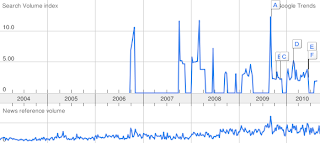
Google trends shows that prior to 2006 there are (by their records) almost no recorded searches of the term "lawmaker" and since that time the relative incidence of the word in "news" articles has roughly doubled. On the last point however, the incidence of "politician" has also increased in news articles over the same period. And, anecdotally, I have very little recollection of the word being used except of late.


This Google news archive search, however, indicates the phrase surged in popularity during the 1980's. Go figure!

So, if there is something to this, I ask myself, why is this word chosen over the 50+ synonyms available or, indeed, "politician" itself? Why choose lawmaker when "political hack", "influence peddler" or "baby kisser" would be a far apter descriptions in the minds of most? I think the answer is bullshit.

Hehe. Actually there is a good argument here. Trust me! Marwan Bishara has an excellent blog and talk show on al Jazeera and in this post ("Peace bullish or "bullshit"?) he paraphrases this excellent definition of the word;

In an attempt to define bullshit and theorise about its uses and meanings, Harry Frankfurt, the Princeton philosopher, has differentiated between bullshit and lies in his book On Bullshit, and concluded that bullshit can be more dangerous than lying.

Bullshit is more than a word; it is a chronic widespread system of rhetoric and representation that mystifies the truth. It has increasingly become a way of communication not only in the private sphere but has become part and parcel of Western propaganda.

Bingo! "Lawmaker" is a way of justifying the political power-structure in the face of increasing discontentment at mainstream politics not providing economic recovery nor moral example (even if both are, most likely, ultimately out of their control, subservient as they are to the tides of international trade and power, but they are leaders nonetheless and thus targets of citizen discontentment). Perhaps the word "politician" is simply, after centuries of wear and tear, suddenly not fit garb for the spokesmen of industry? Or, perhaps more sinisterly, there is meant to be a direct allusion to a stronger, more muscular and straight talking profession; the law enforcer. The twin hammers of the corporate elite; lawmaker and lawgiver. Hmm.

This, I find a little worrying because, even if it is subconscious and I am overly sensitive to weasel words, the more direct alignment of the politician and the political process with that of the legal one smacks of steps towards fascism.

Recently I'm quite interested in the fate of nations where the checks on power-accretion are gradually eroded, Star Wars being the classic sci-fi example (and Lucas makes direct allusions to both Hitler's Germany and Nixon's USA). The problem is time; I have too many questions and not enough knowledge. Is it a one way street? Do nations always go bust, through revolution or war, or can they come back from the brink? Do they see-saw? Find an equilibrium and oscillate? One thing I think is for sure, with the steady emergence of China, Russia, Brazil, India and others, Western hegemony is in decline and this means increased competition, and competition means a threat to existing power structures of all forms, and...

Suu Kyi said the same thing. Peas in a pod, her and Palpatine.

All this said, one must grudgingly accept that supporting such power structures is essential for participation in Great Game. As much as one might campaign for disengagement, there is no practical means to do so without either being strategically worthless (ie. dirt poor) or surrender sovereignty to live under a shield (the Japanese, yet who, thanks to this increase in competition, are being dragged into the Game of late - Obama vs Okinawa).

I read Tariq Ali's book on US policy in South America, primarily Venezuela, and saw this great lecture on Youtube. He doesn't really point a way forward, but if only for his excellent knowledge and "more rounded wit" I find comfort in knowing there are people like him around. Knowledge and acceptance seem to be about the only ways to get to grips with this.