Wednesday, November 17, 2010

Thursday, October 21, 2010

Rove ridicules everyone for being dumber than him

The aide said that guys like me were "in what we call the reality-based community," which he defined as people who "believe that solutions emerge from your judicious study of discernible reality." I nodded and murmured something about enlightenment principles and empiricism. He cut me off. "That's not the way the world really works anymore," he continued. "We're an empire now, and when we act, we create our own reality. And while you're studying that reality—judiciously, as you will—we'll act again, creating other new realities, which you can study too, and that's how things will sort out. We're history's actors…and you, all of you, will be left to just study what we do."

Written by Ron Suskind in the New York Times, October 2004 (though I think the principle outlined pre-dates this significantly in its manifestation), quotes attributed, perhaps, to Karl Rove. This is termed the “Reality-based community”. I'm a big fan of Rove, and am intrigued by the notion he paints, and the problems that lie therein for the modern historian.

a) Is this true?
I’ve been reading a bit of modern history in the middle east region recently, playing catch up on the past 40 years or so of political and military movement, the people and their motives and their actions. One trend that is apparent, dishearteningly, is the way information of events, then news, then analysis, then a delay, then interviews of the involved, then reassessment within a wider context finally results in a public picture that is probably as close to the actuality of the event as is possible to record, but with gaps. Put another way, contemporary news is highly inaccurate and the only rational remedy is patience, which even then doesn’t cure the darkness. This most clearly struck me in the book I’m reading at the moment, from where I originally found the Rove quote, Invisible History: Afghanistan’s Untold Story; it takes 240 pages to reach 2001 (most of this from the 1960’s onwards, in exhaustive, proper noun and acronym detail) and just 90 to cover post 9/11. There is a marked decrease in the quality of the picture presented post 9/11; more unknowns and more speculation, I assume because those involved don’t have the distance to talk about it yet. The quote is true; an empirical-reality-based worldview is behind reality.

b) Extended metaphor
I learnt many things from my Latin teacher, David Thompson, one of which is the extended metaphor. In the Aeneid, Turnus prowls around the Trojan camp like a wolf around a pen; but if you extend the metaphor (or, in this case, simile), the Trojans are sheep. Latin classes were full of useless information like this. I always believed that public school education consisted solely of this kind of teaching.
If the American Empire is an actor, the world is the stage and we are the audience. So far so good. If the production is of a high quality, the audience must work hard to understand the play; the intricate speech, nuances of look and movement, patterns of ideas that run through lines, scenes and the play as a whole; likely it can only be fully grasped sometime after the performance ends. Still holds true.
The actors do not break the fourth wall, even if they let us “in” through soliloquy, we are “in” on their terms and they are most certainly not “out”. The Empire feeds us with “news” like an honest confidant.
But something we rarely ask of ourselves is; is the narrator/author reliable? Or, are we ourselves a good audience? Do we afford the appropriate levity and consideration to each scene? These are interesting questions in themselves, but, of course, they do not solve the problem presented of being, necessarily, behind the fact of the events of the play.

How does the audience see Iago for what he is from the moment he opens his mouth for the first time?
How can the audience prevent Iago from creating his own reality and watching as the victims themselves act out his self-fulfilling-prophesy/dream?

I don’t quite, yet, believe the Empire to be equatable to Iago, and thus I do not see the need for it to be stopped for there is great potential to do great good through a one-power system (and perhaps an equal potential to do great harm, eh?). But for my intellectual curiosity, sparring with Karl Rove’s logic is a decent way to spend my time, and finding some way to understand the Empire now, and its future, even if through abstract metaphors, should be interesting.

(Of course, in an obvious sense, it is not a difficult problem; one must predict the actor based on what he has done already, and within the wider context of the other characters and the situation of the play... but this is not so simple, and to go down this route requires hermeneutic (interpretation) theory and so on...)

Ponder on this, I will.

Sunday, September 26, 2010

Lawmaker


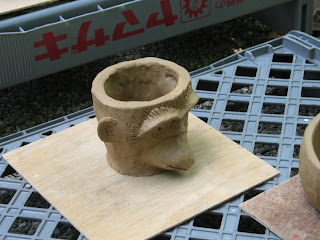
This is Summer Chimp; he came back glazed! A rather handsome simian, to be sure.

A rather irritating trend I've noticed in the media, both printed and online, is the tendency of late to call politicians "lawmakers". I think I'm laying most of the blame for this with the Associated Press, which supplies far too much news for it to be reliable, but the term does seem to have been adopted rather widely. Why do I say adopted?

Well, for one, it calls attention to itself since I think, for many people, it is not an intuitive synonym for "politician". To be sure, they do propose and vote on laws (with a great deal of help in both regards from civil servants and lobbyists), but "making" seems too prescriptive, too dictatorial, for a system that has been extant for centuries and is largely modelled around basic human morality anyway. What new laws do they "make", exactly? More on this, but first some rather flimsy evidence...


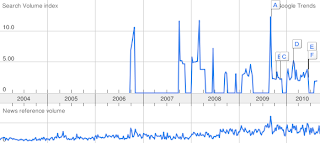
Google trends shows that prior to 2006 there are (by their records) almost no recorded searches of the term "lawmaker" and since that time the relative incidence of the word in "news" articles has roughly doubled. On the last point however, the incidence of "politician" has also increased in news articles over the same period. And, anecdotally, I have very little recollection of the word being used except of late.


This Google news archive search, however, indicates the phrase surged in popularity during the 1980's. Go figure!

So, if there is something to this, I ask myself, why is this word chosen over the 50+ synonyms available or, indeed, "politician" itself? Why choose lawmaker when "political hack", "influence peddler" or "baby kisser" would be a far apter descriptions in the minds of most? I think the answer is bullshit.

Hehe. Actually there is a good argument here. Trust me! Marwan Bishara has an excellent blog and talk show on al Jazeera and in this post ("Peace bullish or "bullshit"?) he paraphrases this excellent definition of the word;

In an attempt to define bullshit and theorise about its uses and meanings, Harry Frankfurt, the Princeton philosopher, has differentiated between bullshit and lies in his book On Bullshit, and concluded that bullshit can be more dangerous than lying.

Bullshit is more than a word; it is a chronic widespread system of rhetoric and representation that mystifies the truth. It has increasingly become a way of communication not only in the private sphere but has become part and parcel of Western propaganda.

Bingo! "Lawmaker" is a way of justifying the political power-structure in the face of increasing discontentment at mainstream politics not providing economic recovery nor moral example (even if both are, most likely, ultimately out of their control, subservient as they are to the tides of international trade and power, but they are leaders nonetheless and thus targets of citizen discontentment). Perhaps the word "politician" is simply, after centuries of wear and tear, suddenly not fit garb for the spokesmen of industry? Or, perhaps more sinisterly, there is meant to be a direct allusion to a stronger, more muscular and straight talking profession; the law enforcer. The twin hammers of the corporate elite; lawmaker and lawgiver. Hmm.

This, I find a little worrying because, even if it is subconscious and I am overly sensitive to weasel words, the more direct alignment of the politician and the political process with that of the legal one smacks of steps towards fascism.

Recently I'm quite interested in the fate of nations where the checks on power-accretion are gradually eroded, Star Wars being the classic sci-fi example (and Lucas makes direct allusions to both Hitler's Germany and Nixon's USA). The problem is time; I have too many questions and not enough knowledge. Is it a one way street? Do nations always go bust, through revolution or war, or can they come back from the brink? Do they see-saw? Find an equilibrium and oscillate? One thing I think is for sure, with the steady emergence of China, Russia, Brazil, India and others, Western hegemony is in decline and this means increased competition, and competition means a threat to existing power structures of all forms, and...

Suu Kyi said the same thing. Peas in a pod, her and Palpatine.

All this said, one must grudgingly accept that supporting such power structures is essential for participation in Great Game. As much as one might campaign for disengagement, there is no practical means to do so without either being strategically worthless (ie. dirt poor) or surrender sovereignty to live under a shield (the Japanese, yet who, thanks to this increase in competition, are being dragged into the Game of late - Obama vs Okinawa).

I read Tariq Ali's book on US policy in South America, primarily Venezuela, and saw this great lecture on Youtube. He doesn't really point a way forward, but if only for his excellent knowledge and "more rounded wit" I find comfort in knowing there are people like him around. Knowledge and acceptance seem to be about the only ways to get to grips with this.
Wednesday, July 21, 2010

Summer Chimp

(delayed post, from July 21st 2010)

It is very hot and humid in Shizuoka at the moment; the season of eternal perspiration where I guzzle what seems like over 3 litres of fluids each day. (Nothing makes fruit juice and milk taste better than a run in the summer.)

Have just read an excellent book called "Catching Fire" by Richard Wrangham on his theory that cooking was the prime evolutionary catalyst for many adaptations that make us human; from physically smaller guts and jaws to pair-bonding (marriage) arrangements, the sexual division of labour and cooperation. I'm totally sold on his argument, and only wish he'd come up with it when I was studying anthropology because it is such a simple but wonderful idea that fits so much better than the "compulsive communicator" or "aquatic ape" hypotheses I had to learn. It's very easy to read with lots of fascinating anecdotes, you should pick it up!

On Sunday and Monday we went for a BBQ/camp-in-a-hut trip near lake Yamanaka (one of Fuji's five lakes) with some other couples (Nami's Uni friends). We had a good time cooking and drinking. The weekend provided me with some handy anthropological field study as I could observe human behaviour around the campfire. I bought a small Primus gas stove with which I intend to make "Himalayan Sherpa Tea" (no kidding, that's the brand name) at the top of Mt. Fuji in a couple of weeks, and tested it out when camping, but ended up boiling water for coffee for ten people. It works a treat though.

On the second day of the camp, before we (I) drove home, Nami had organised for everyone to do some crafts, most did pottery. With the anthropology book in hand, I set out to make a chimp/proto-human mug...


Now I think about it, kind of looks like the early humans from "2001"... hmm! I could choose between a white glaze or none. I went with none and hope to scratch and shape him a bit more when he arrives fired. Suggestions for a name welcome!

Thursday, June 3, 2010

Yukio Hatoyama, the Prime Minister who wasn't a politician

This week, Yukio Hatoyama resigned and took Ozawa with him making him the latest in a string of Prime Ministers that couldn't survive more than a year since Koizumi privatised the largest savings fund in the world (Japan Postal Savings) and pushed away from China with repeated visits to Yasukuni Shrine. He was very popular in the States.


Hatoyama, not so much. He was so promising; the massive swing election last year overthrew 50 years of almost uninterrupted Liberal Democratic Party of Washington sock-puppetry, he vowed to sweep out corruption and bureaucracy and take a more Asian-centric stance to foreign policy which included the relocation of American bases on Okinawa. But poor Hatoyama moved too fast, and within months the Americans were complaining of a breakdown in communication (read: all their LDP cronies and bureaucrats were no longer in the loop).

Soon after the election, Okinawa Base rumblings came from the US.

August 2009 - "Unfortunate"
September 2009 - "Won't dictate to Japan"
October 2009 - "Japan urged"
November 2009 - "USA warns Japan"
Late December 2009 - "US concerned about Hatoyama"

Back in October, the US started stinging Japanese exports with a Toyota "acceleration problem" that turned out to be people jamming their mats to the pedals. The president of Toyota was made to answer pointless, inarticulate questions at a congressional hearing...


Honda too was hit by a recall.

And Hatoyama was criticised for accepting money from his mum and dead people.

Then North Korea apparently sunk a South Korean Navy vessel. Only China didn't quite believe the story, but it was reported endlessly on Japanese news. A reporter for Russia Today said exactly what I was thinking on this, but much more eloquently.


(The US (and S.Korea?) staged a false-flag attack to put pressure on Japan to maintain their presence in Okinawa and the region)

And Hatoyama collapsed, announcing the base will only move to another part of Okinawa as per a 2006 agreement that was already in place. The Social Democratic Party, in coalition with Hatoyama's DPJ, split over this backdown. Next month, upper house elections begin and with Hatoyama's approval rating supposedly down from 70% to 20%, a quick leader swap was in order for the DPJ to minimise the damage from trying to screw with America.

Now I like to draw parallels with fiction, and the Japanese made animation Ghost in the Shell (2nd series) covers an almost identical narrative. The plot goes, following non-nuclear World War III and the 2nd Vietnam war, Japan has a massive population of Asian refugees that are causing civil unrest. The crime of the series is perpetrated by a member of the Cabinet Intelligence Serivce, Gouda, who orchestrates a series of proxy and false-flag attacks to incite a refugee uprising that has supposedly acquired a Russian nuclear bomb. Actually, they didn't, but in the ensuing conflict between refugees and Japan's Self Defence Force Gouda arranges, via the CIA, for the American Empire to launch a nuke from a sub to detonate over the refugee's city, thus the authorities can claim they mishandled the bomb and set it off themselves (a false-flag attack), thereby resolving the issue and pushing Japan into a more economic and militarily subservient position with the American Empire. The heroes of the story, Public Security Section 9, prevent the sub's nuclear attack, thereby saving the refugees, and kill Gouda before he can defect to the US.

In reality, the US is, I think, remarkable in its pragmatic willingness to actively create situations, to create news, to create war in order to control events, manipulate players and provide a context for its own desired course of action. Most countries can't hold a candle to the kind of resources the US puts into controlling their governments, and Hatoyama has learned this the hard way by being attacked from within and without, militarily and economically and politically; arguably all orchestrated at some level by the US. The poor chap is now in a situation where his choices have indirectly lead to economic damage to Japan's core industries, unemployment, military action and loss of life, the dissolution of his ruling coalition and his own resignation. If the effects weren't so bad, one might call his stand against America admirable, but really it was just terribly ill conceived.

Going back to the Ghost in the Shell story, one might be tempted to say that Japan needs a better intelligence agency. One that doesn't have 75% of its staff come from other countries. If they had an organisation like Section 9, or better press control, they might have been able to minimise the US/South Korean scaremongering, and ultimately save Hatoyama, perhaps? But this is reactionary, and it wouldn't dramatically change the political landscape.

Japan needs to improve its bureaucracy. From the drones sitting doing nothing at city hall, the five people it took to issue me with a new bank book, to ludicrous nepotism and bribery at the top levels of government, there needs to be the kind of reform Hatoyama promised (not least for the economic waste). And I think this can only happen if they establish a strong multi-party democratic system rather than the virtual oligarchy that has just lost power and seems to be rather quickly clawing its way back. Specialization breeds weakness that can be controlled, diversification creates flexibility and resilience. One party systems can be controlled as easily from within the nation as from without, but always become oppressive when threatened. So...

The DPJ needs to make itself into a viable second leadership, not an opposition, and this means playing along with America, at least for the time being. Hatoyama has blown his chance, and possibly that of the DPJ in this term if they can't secure a majority in the upper house elections.


Here is the next chap, Naoto Kan. I hope he has more political skill and a more realistic vision of Japan and its place between America and China. And that he can stay in power for longer than it takes for a dried senbei to go bad.


Here are the three musketeers of the DPJ; Hatoyama, Ozawa and Kan. Mr. Kan is the last one standing...

Tuesday, February 23, 2010

Rageh

Watched a rather good documentary Rageh Omaar did for BBC4 on life in Iran today...


And a more historical perspective on Iran that was very interesting, relevant, and though a year or so old, slightly prophetic...


Though as it turned out, apparently Rageh wasn't too chuffed at the BBC and jumped ship to Al Jazeera, and has a new show, "The Rageh Omaar Report", kind of Rageh Unleashed, where he can go globe trotting and interviewing people on topics to his interest. Which interests me immensely.

Update: Here he is...

Friday, February 12, 2010

David Erchamion: The One Handed

So we went to Mt. Fuji yesterday with friends to go sledging or skating, the latter as it turned out, and I injured myself in true You've been framed! style. Walking to the small skate rink, I suggested we walked down a hill, not the path. Then due to some imbecilic precociousness, and perhaps a nostalgia for childhood wrongfootings, I decided to walk down an icy patch on the hill. Feet came out, arms flailed and I landed on my back. Everything would have been wonderfully comic, though it still is I guess, but when I tried to break my fall with my hand, that slipped too, naturally, and twisted my arm in some impossible contortion.

Suffered relatively silently the rest of the day, and refused to go to the hospital since I reasoned that humans wouldn't have gone to hospitals for millions of years before they were invented. But then I guess humans generally have a more healthy fear of ice than me, as it turned out. I partly rationalise my fall as a result of having suffered no injury within memory; so I thought I was some kind of indestructible Achilles type. Speaking of which, I believe I did some decent ligament and/or tendon damage to my left elbow. Or maybe I actually am indestructible, and it's just my left elbow that is weak? The "David Elbow", one's weakness due to inane stupidity.

After not much sleep, Mariko took me to a doctor this morning. Took a couple of X-rays. He gandered at them for a while and made lots of non-committal Japanese mumblings... not broken as I thought (and hoped) but didn't even suggest ligament injury. Gave me a cold compress (though I really dislike symptomatic treatments), a sling (though I was doing fine with one of Nami's scarves) and some painkillers (see symptomatic treatment dislike). But at least probably not broken, which was the reassurance I was looking for!

Meantime I am one handed like the hero Beren...

A striking likeness

Though temporarily so. And kind of 1.1 handed, the left hand serves as an immobile T-Rex claw for doing light holding work. Meantime, I spent all day watching excellent YouTube videos about the Sumerians...


and good old American economics...


And sleeping...